Categories
Uncategorized

Our letter to Vice-Chancellors on educide in Palestine

This letter was sent to VCs at UK universities on 6 February 2024

Dear Vice Chancellor,

In light of the provisional measures ordered by the International Court of Justice (ICJ) against Israel in relation to breaches of the Genocide Convention, we are writing to you on behalf of the British Society for Middle Eastern Studies Campaigns (BRISMES Campaigns) to request that your university do more to support educators and the education system in the Gaza Strip.

Over the past four months we have witnessed Israel’s wholesale destruction of the education system in Gaza, which is made up of over 625,000 students and about 23,000 teachers and professors, all of whom have been impacted by the war. As at 24 January 2024, Israel had killed 4,327 students and injured 8,109. Further, Israel had killed 231 teachers and administrators and injured 756. The number of students and educational staff killed in such a short period is unprecedented in the region’s history. Those students and teachers who have not been killed are among the more than 1.7 million people who have been forcibly displaced and who are living in overcrowded and unsanitary shelters or sleeping in the open. Like the rest of the population in Gaza, they are at risk of dying of hunger and disease, with no access to food, potable water, electricity, heating or medicine. Whereas we focus on Higher education, we contextualize the educational system in Gaza to grasp the long-term destruction that amounts to Educide. Israel has destroyed Higher Education infrastructure in Gaza on a massive scale, the impact cannot be understood outside the massive destruction of middle and elementary education and staff, taken together this illustrates how a whole school generation is destroyed.

Israel has systematically destroyed all of Gaza’s universities. On 17 January, Israel blew up Al-Israa University, the last university left standing in Gaza. Footage shared by the BBC shows the university being completely destroyed. This act of wanton destruction follows the repeated targeting by Israel of Gaza’s universities since the start of its military operation: the Islamic University and the University College of Applied Sciences were bombed on 11 and 19 October, respectively. On 4 November, Israeli forces bombed Al Azhar University, the second largest university in Gaza, and this was followed by the destruction of Al Quds University on 15 November. The medical school in the Islamic University was bombed on 10 December, while Al-Aqsa University and the Palestine Technical College have also been severely damaged.

In addition to the destruction of universities, a majority of school buildings in Gaza have been damaged. Israeli soldiers have filmed some of their acts of destruction, including in one video which shows the moment the Israeli army blew up a UN school in Beit Hanoun in December. As a result of the destruction of Gaza’s schools, hundreds of thousands of children who have already been deprived of education for several months will not have a school to return to once Israel’s attacks subside. Moreover, Israeli forces have attacked multiple schools serving as temporary shelters, killing Palestinians who sought refuge in them. For example, in November 2023 Israeli forces attacked the UNRWA-run Al-Fakhoura and Al-Buraq schools, killing at least 40 people and wounding many others, while in December 2023, they killed 15 Palestinians in attacks on Shadia Abu Ghazala School.

Alongside the decimation of the physical infrastructure of higher education in the Gaza Strip, Israeli forces have killed 94 members of Gaza’s higher education community, including numerous internationally respected scholars, who comprised part of the region’s intellectual leadership. These include Professor Sufian Tayeh, president of the Islamic University of Gaza, Professor Muhammad Eid Shabir, a microbiologist and Tayeh’s predecessor at the university for 15 years, Dr Said Al-Zubda, president of the University College of Applied Sciences, and Professor Refaat Alareer, co-founder of the ‘We Are Not Numbers’ project and one of Gaza’s most prominent intellectuals.

As you will no doubt be aware, Israel’s killing of students and academic staff and its deliberate destruction of educational infrastructure constitute breaches of international humanitarian law, which requires Israel to take all feasible measures to spare civilians and civilian objects. It is self-evident that Israel has failed to comply with these requirements. As the UN Secretary General noted in late October, ‘we are witnessing…clear violations of international humanitarian law…in Gaza’. Further, as South Africa argued before the ICJ, Israel’s attacks on education and students should be viewed as further evidence that Israel is deliberately inflicting on Palestinians in Gaza conditions of life calculated to bring about their destruction, in contravention of the Genocide Convention. As you will be aware, the ICJ has ruled that South Africa’s case that Israel has committed genocide in Gaza is a plausible one.

In light of all of the above, we request that your university do the following:

  1. Condemn Israel’s destruction of the education system in the Gaza Strip and express support for Gaza’s universities, staff and students, just as UK Universities did in regard to Ukraine’s higher education system within a month of Russia’s invasion of Ukraine. Failure to do so now would raise serious questions about the consistency of moral standards at UK universities. 
  2. Review all partnerships, including research cooperation, student exchange programmes, and funding relations, with Israeli educational and other institutions, and end any relation that might be connected to ‘plausibly genocidal acts’ within the terms of the ICJ ruling, including support to the actions of Israeli armed forces and acts of genocidal incitement carried out by members of Israeli institutions, as well as discriminatory or recriminatory actions against Jewish and Arab Israelis who have criticized the war in Gaza.
  3. To commit to set up placements, fellowships and scholarships for new students from Palestine, as well as hardship funds for students affected by the war on Gaza, and to enhance provision of placements for existing Palestinian academics and students, including through the British Academy’s Researchers at Risk Fellowship Programme, which is supporting Ukrainian researchers affected by the war in Ukraine but is not supporting Palestinian researchers.
  4. To actively support Palestine’s universities through inter-institutional cooperation, including virtual exchanges, library sharing and infrastructural support. We note with regret that there are currently no partnerships between UK universities and universities in Gaza, exposing a clear double standard when set against the response to Russia’s attack on Ukraine: within four months of Russia’s invasion, 71 partnerships were in place with Ukrainian universities, and UK universities had ‘come forward in droves to support their Ukrainian counterparts, backed by UK Government initiatives and funding’. We expect UK universities to support their Gazan counterparts in the same way.

We kindly ask you to respond within two weeks of receipt of this letter. We look forward to your response.

Sincerely,

BRISMES Campaigns
Categories
Uncategorized

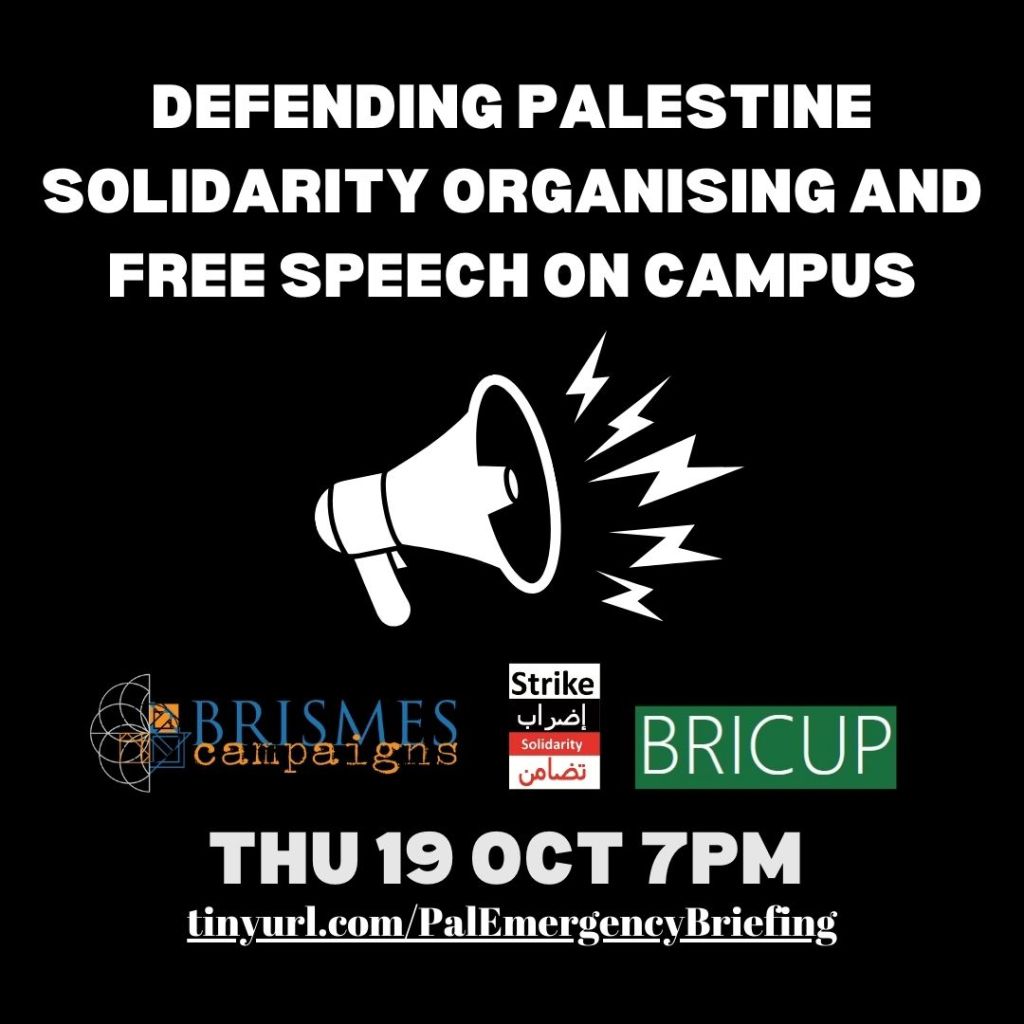
Emergency briefing: defending Palestine solidarity organising and free speech on campus

This event took place on Thurs 19 October, 7pm 

The brutal bombardment of the civilian population of Gaza by Israeli forces and the forced removal of over 1 million Palestinians from their homes has brought hundreds of thousands onto the streets in protest. Yet students and academics who have spoken up on social media and at demonstrations have been targeted by hostile media campaigns. University managements have banned or restricted meetings against Israeli apartheid and occupation on campus. And government ministers and the police have created a climate of fear by threatening to criminalise using the Palestinian flag and pro-Palestinian slogans. 

  • How can we, as university and college workers, trade union activists and students work effectively to defend pro-Palestinian voices and organisers? 
  • How can we ensure that our universities and colleges stand up to government pressure and support critical teaching and research on the roots of the conflict which examines the history of settler colonialism, apartheid and occupation? 
  • What should campus trade unions do to protect the right to protest, boycott and organise in solidarity with Palestine? 

Hosted by BRISMES Campaigns, BRICUP and MENA Solidarity Network

Chair:

  • Sean Wallis (UCU London Region)

Speakers included: 

Resources

Categories
Uncategorized

Statement from BRISMES Campaigns Regarding the Earthquake in Morocco

BRISMES Campaigns is devastated by the destruction in the aftermath of the Friday evening 8 September earthquake in Morocco. Our thoughts are with our friends and colleagues and all who have been impacted. We offer our deepest condolences for those you have lost, and hope you are reunited with missing loved ones soon.  

Thousands of people have died, are dying as we speak, or are badly injured. Many more are homeless and severely traumatised. The regions of Ouarzazate, El Haouz, Chichawa, and Taroudant belong to a part of Morocco that still carries the scars of colonial underdevelopment and postcolonial marginalization. The towns hit by the earthquake are remote and poor. They get very wet, cold and snowy in the winter. Though the places in and around the epicentre are hard to reach, in numerous devastating social media messages university lecturers and school teachers have reported the loss of their students, of homes and schools that disappeared, and the destruction and death of complete villages in the Atlas mountain region. The race against the clock is real, the number of casualties will rise, and efforts made in the aftermath will be crucial. 

Dozens of initiatives have emerged to collect donations, and several colleagues in the UK work with local NGOs and community leaders. Driss Ksikes, Director of Economia, LCI Research centre in Rabat told us, “Teachers have announced that they’ve lost all their students in the villages. Teachers from across the country are banding together to help, in coordination with local organisations.” Rachida Azough, who coordinates Moustaqbel’s Education Support Unit, notes, “We know the families of our students, so reconstruction is not that complicated for us. We give the funds directly and they do what is necessary with it. People need a roof over their heads. We know that the aftermath, the reconstruction phase, is the moment when most aid ends, and we’re ready to help our students rebuild their lives.”

We encourage all BRISMES members to contribute to relief efforts, and to extend support to affected colleagues at their universities. Whilst we cannot endorse any particular organisations running relief campaigns, members who are looking for ways to help those affected may wish to find out more about the organisations below, including those supporting educators and their students.

Categories
Uncategorized

Statement in solidarity with Palestinian human rights defenders

#StandWithThe6

This statement has been drafted collaboratively by early career academics who are concerned for the lives of Palestinians and how the misuse of anti-terror laws both by the Israeli government and other governments globally prevents crucial solidarity and academic work being conducted. Scholarship on terrorism cannot be pulled apart from international politics and it is vital we take a stand and try to effect change.  

To add your name to the letter, follow this link.

We, academics, researchers and practitioners in the fields of Terrorism Studies, Middle Eastern Studies, Human Rights and Public International Law strongly condemn the Israeli Ministry of Defence’s recent designation of six Palestinian civil society groups as ‘terrorist’ organisations. This unsubstantiated designation is based on false allegations.

The recent proscription of the Palestinian groups Addameer, Al-Haq, the Bisan Center, Defence for Children International Palestine, the Union of Women’s Committees and the Union of Agricultural Work Committees, comes in the context of Israel’s decades-long military occupation of Palestinian territory and its numerous violations of Palestinian human rights, under a discriminatory system that international human rights organisations, such as Human Rights Watch and Bt’selem, have widely condemned. This crackdown against Palestinian civil society groups is an extremely worrying escalation in Israel’s attempt to further curtail Palestinian’s resistance against occupation, and prevent the documentation of violations against human rights. These groups engage in lifesaving work that benefits the large proportion of disenfranchised Palestinians who face on a daily basis the violence of dispossession, and increased restrictions on civil and basic human rights.

UN human rights experts have condemned the false designation calling it a ‘frontal attack on the Palestinian human rights movement’. Criminalising the work of these groups, which are a lifeline to hundreds of Palestinian families, is meant to stifle any form of resistance, survival and meaningful and dignified living. The barring of these groups under the anti-terror law also works to criminalise anyone who finances or supports them. Two hundred and forty-one regional and international organisations have called for Israel to repeal its Anti-Terrorism Law (2016), stating that ‘it does not meet basic human rights standards’.

As researchers who engage in critical work on Middle Eastern Studies, Terrorism and Political Violence, and Human Rights in general, we believe our concerns are legitimate and valid, and foresee a frightening increase in the misuse of counter terrorism legislation globally. We are extremely concerned for the safety of members of the six organisations and the Palestinian families and individuals who rely on their support. We are equally concerned for the wellbeing and safety of researchers and practitioners who work with these organisations, and those who work to shed light on the plight of Palestinians in the occupied territories. We hold the Israeli government fully responsible for the safety of the employees of these legitimate NGOs.

The misuse of counter terrorism legislation to curtail human rights and undermine civil liberties is a dangerous precedent. The international community should prevent governments from violating basic human rights that are guaranteed by the United Nations’ charter and other international and regional treaties and legislation. We stand in solidarity with these organisations who do vital work. We call on to the international community to exert rightful pressure on the Israeli government to repeal the proscription of the six Palestinian civil rights organisations. We also call on the Israeli government to cease the misuse of anti-terror laws against civil society organisations in the occupied Palestinian territories and to end the military occupation of Palestinian territory. We further call upon Higher Education institutions to publish statements condemning this designation.

Your name will be added below and this statement will be shared with the six Palestinian organisations.
If you have any queries or want to make changes to your name, please email standwiththe6@gmail.com

Signed:

Dr Adam Elliott-Cooper, Lecturer, Department of Politics and IR, Queen Mary University of London
Dr Afaf Jabiri, Senior Lecturer, University of East London
Ahmed Abozaid, University of St Andrews
Dr Alessandra Mezzadri, Senior Lecturer Development Studies, SOAS University of London
Alice Finden, PhD candidate in critical terrorism studies, SOAS, University of London
Alistair Davison, Executive Director, Cordoba Peace Institute – Geneva
Amna Kaleem, PhD Researcher, University of Sheffield
Dr. Anna Meier, Assistant Professor, University of Nottingham
Dr Anne Alexander, Research Associate, CRASSH, University of Cambridge
Professor Arshin Adib-Moghaddam, SOAS University of London
Professor Azrini Wahidin, University of Warwick
Dr Barbara Pizziconi, Reader in Japanese Applied Linguistics, SOAS, University of London
Barbara Schenkel, PhD candidate, SOAS, University of London
Bethany Elce, PhD student, SOAS
Dr Busra Soylemez-Karakoc Bucknell University
Chaeyoung Yong, PhD candidate, University of St Andrews
Chougrani
Dr Christian Henderson, Assistant Professor, Leiden University
Dr Clive Gabay, Reader in International Politics, Queen Mary University of London
Professor Dina Matar, SOAS, University of London
Dr Darryl Li, Assistant Professor of Anthropology. University of Chicago
Darya Tsymbalyuk, PhD researcher, University of St Andrews
Dr David Wearing, Post Doctoral Research Associate, SOAS University of London
Dr Emily Jones, Senior Lecturer in Law, University of Essex
Dr Emily Regan Wills, Associate Professor, School of Political Studies, University of Ottawa
Frederic Schneider, Senior Research Associate, University of Cambridge
Professor Gilbert Achcar, Professor of Development Studies, SOAS, University of London
Professor Goldie Osuri, University of Warwick
Dr. Hannah Bargawi, SOAS University of London
Dr Hsinyen Lai, Associate Lecturer, St Andrews
Dr. Imad Mustafa, University of Erfurt (Germany)
Professor Jan Selby, Professor of Politics and International Relations, University of Sheffield
James Godfrey, PhD Researcher, Birkbeck, University of London
Dr Jared Ahmad, Lecturer in Journalism, Politics and Communication, University of Sheffield
Dr Jasmine K. Gani, Senior Lecturer in International Relations, University of St. Andrews
Dr Jeff Handmaker, Associate Professor, Erasmus University Rotterdam
Dr Jennifer Philippa Eggert, independent researcher
Professor John Chalcraft, LSE
Joude Bazzoun, student, University College Utrecht
Professor Laleh Khalili, Professor of International Politics, Queen Mary University of London
Dr Lewis Turner, Lecturer in International Politics, Newcastle University
Lilly Barker, PhD student, Nottingham Trent University
Professor Lindiwe Dovey, Professor of Film and Screen Studies, SOAS University of London
Dr Lisa Stampnitzky, Lecturer in Politics, University of Sheffield
Dr Lori Allen, Reader, Department of Anthropology, SOAS
Lucia Kula, Lecturer in Law & Gender, SOAS University of London
Professor Lynn Welchman, School of Law, SOAS, University of London
Madlen Nikolova, Doctoral candidate, Department of Politics, University of Sheffield
Dr Malaka Mohammed, the University of St Andrews
Professor Mandy Turner, Professor of Peace and Conflict Studies, University of Manchester
Dr Manjeet Ramgotra, Senior Lecturer, SOAS University of London
Dr Maria Norris, Assistant Professor, University of Coventry
Dr Mazen Masri, Senior Lecturer, The City Law School, City University of London
Dr Melanie Richter-Montpetit, Senior Lecturer in International Security, University of Sussex
Mekia Nedjar International Relations Lecturer
Mira Al Hussein, PhD Candidate, University of Cambridge
Professor Miriam R. Lowi, The College of New Jersey, Ewing, NJ, USA
Mohammad AlYousef
Nama’a, Doctoral Researcher at Delft University of Technology
Professor Neve Gordon, Professor of Human Rights, School of Law, Queen Mary University of London
Professor Nicola Pratt, Professor of the International Relations of the Middle East, University of Warwick
Dr Nisha Kapoor, Associate Professor, University of Warwick
Nivi Manchanda, Queen Mary University of London
Dr Omar Dahi, Associate Professor, Hampshire College
Dr Paola Zichi, Postdoctoral Researcher, Queen Mary, University of London
Pietro Stefanini, PhD student, University of Edinburgh
Dr Piers Robinson, co-director, Organisation for Propaganda Studies
Prerana Pai Bhande, Student, University College Utrecht
PhD candidate at the University of St Andrews (anonymous)
Dr Rabea Khan, University of St Andrews
Dr Rahul Rao, Lecturer in International Political Thought, University of St Andrews
Professor Raymond Suttner, Emeritus Professor, University of South Africa
Professor Richard Jackson, University of Otago, New Zealand
Ronit Matar, PhD candidate/assistant lecturer, School of Law, University of Essex
Dr Sai Englert, Lecturer, Leiden University
Sam Morecroft, Anti-Casualisation Officer, USIC UCU
Dr Sharri Plonski, Senior Lecturer in International Politics, Queen Mary University of London
Shirin Rai
Shreeta Lakhani, Senior Teaching Fellow in Gender Studies, SOAS, University of London
Endowed Professor Stellan Vinthagen, University of Massachusetts, Amherst
Dr Subir Sinha, Reader in Development Studies, SOAS, University of London
Dr Tara Van Ho, Senior Lecturer, University of Essex School of Law and Human Rights Centre
Dr Tanzil Chowdhury, Lecturer in Public Law, Queen Mary University of London
Professor Tim Jacoby, University of Manchester
Thomas Reid, PhD, University of St Andrews
Dr Tom Pettinger, Research Fellow, University of Warwick
Dr Tor Krever, Assistant Professor of Law, University of Warwick
Professor Virinder Kalra, University of Warwick
Zalina Abdul Halim, PhD candidate, University of Malaya
Zouhair Hammana, PhD candidate, Erasmus University Rotterdam

(List of signatories updated on 25 January 2022. For the latest list of signatories, see here.)

Categories
Uncategorized

BRISMES Campaigns launch

Our launch event at BRISMES Conference on 7 July 2021 heard from campaigners, scholars and renowned Palestinian poet Fady Joudah about why translating academic privilege into concrete forms of solidarity and action has never been more urgent. Watch the recording of the livestreamed event above.

Chair: Hicham Safieddine

Panellists:

Omar Barghouti, Palestinian Campaign for the Academic and Cultural Boycott of Israel

Sara Salem, LSE

John Chalcraft, LSE

Marcy Newman, Founding member of the US Campaign for the Academic and Cultural Boycott of Israel

Fady Joudah, Poet and Translator

Categories
Uncategorized

Middle East Studies in Practice and Anti-Colonial Education

Wednesday 7 July 2021, 3.15-5.15pm

BRISMES Conference online

Chair: Hicham Safieddine

Panellists:

Omar Barghouti, Palestinian Campaign for the Academic and Cultural Boycott of Israel

Sara Salem, LSE

John Chalcraft, LSE

Marcy Newman, Founding member of the US Campaign for the Academic and Cultural Boycott of Israel

Fady Joudah, Poet and Translator